Thursday, September 8, 2016

Independence Fighter


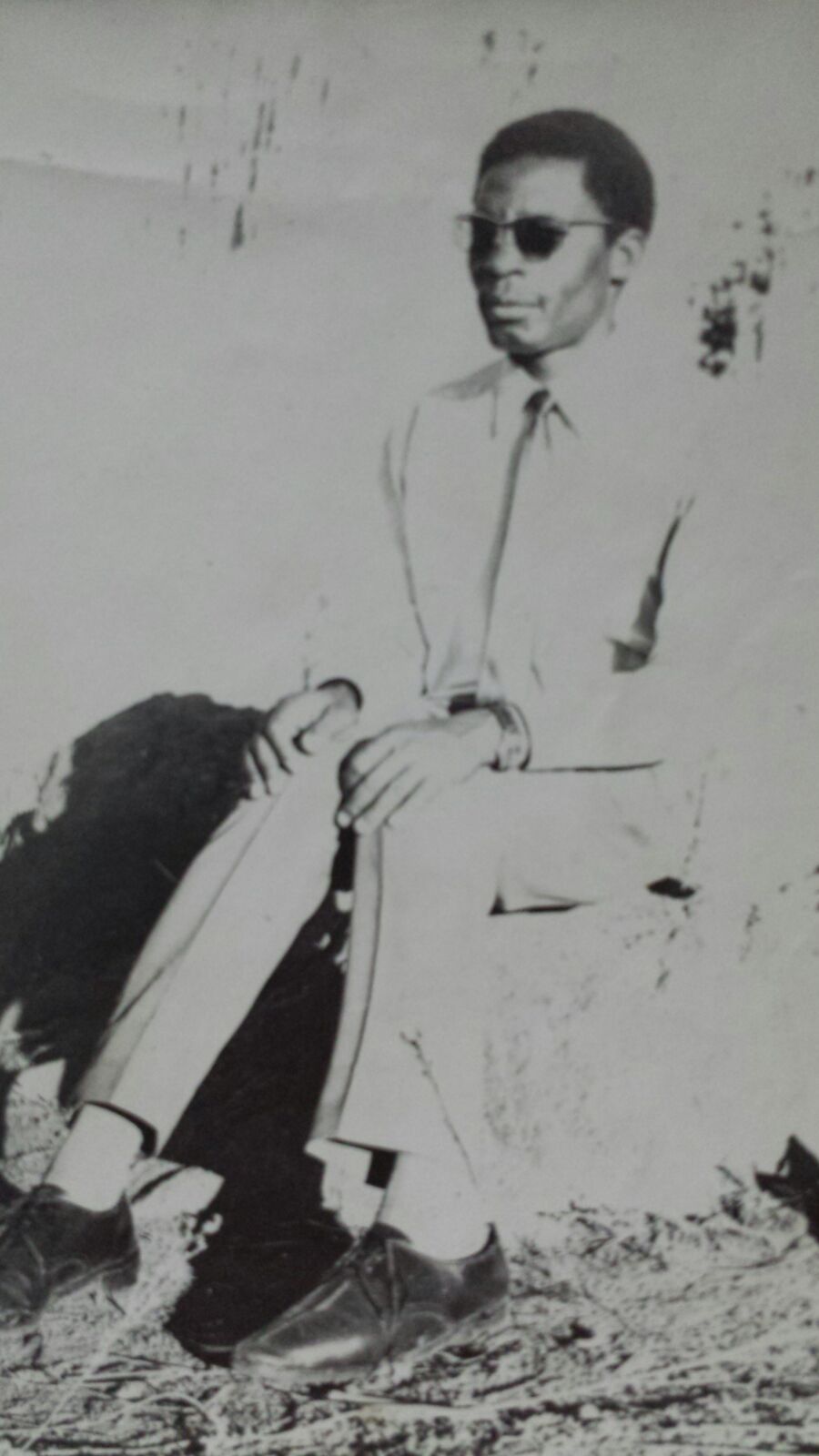
Martin Chirwa during the time period presented in this blog

Events during the 1958 to 1964 phase of Martin Chirwa’s life helped define his view of the world and shape the rest of his life. More importantly, this time period impressed on him how he would raise his children. It is not an accident that this period coincided with the climax of the independence phase of the nation of Malawi.

At the time Martin Chirwa was starting school at Chikhutu in 1948, his teacher Grayson Chikanda had a young family. The rest of the family will be introduced later but for now let it suffice to bring to the reader’s attention that Grayson and his wife Jane had a second born daughter named Elinart who was born on 25th May 1941. After establishing the school at Chikhutu, Grayson Chikanda was transferred to Nkhoma and later to Dzenza (currently on the edge of the city of Lilongwe). Martin continued to be in contact with his teacher and visited him and his family from time to time. By the time he finished school at Namitete, these visits had drawn him to Elinart and he fell in love with her. 

When Martin found a job at the Post Office in Limbe, he proposed to Elinart for a hand in marriage. Elinart was hesitant because at 17 she had plans. She had an eighth grade education and had ambitions to become a nurse. But Martin convinced Elinart that he was going to take care of her. So the two got married in 1958 and went to live in Blantyre.

Martin and Elinart Chirwa in 1988

To put the events in Martin’s life from 1958 to 1964 in perspective, the colonial history of Malawi needs to be revisited.

David Livingstone came from Scotland to Malawi as a missionary/explorer in 1859. Three types of British settlers followed Livingstone’s visit. The first type was made of Presbyterian and Anglican missionaries. The second type was made of farmers. And the third type was made of British business people who came to trade with the missionaries and farmers. Livingstone personally pushed for the settlers to come. His rationale was that it would help fight slave trade. At that time, Arabs came to Malawi and bought slaves from chiefs using salt and clothing. The Arabs then sold the slaves in Zanzibar to people from Europe and the Americas .

The settlers sought protection from the British government. A British Central Africa (BCA) protectorate was established in Malawi in 1860. The settlers gave the name of Nyasaland to Malawi. In 1891 the BCA became the Nyasaland Region Protectorate and then simply the Nyasaland Protectorate in 1907. In 1953, the British Colony of Southern Rhodedia (now Zimbabwe), the Northern Rhodesia Protectorate (now Zambia), and Nyasaland were merged into a British run semi-independent country called Federation of Rhodesia and Nyasaland run by the settlers.

There was a political group of Malawian Africans called Nyasaland African Congress (NAC) that was fighting for independence. This group decided they needed a messiah figure to start an uprising in the fight for independence. They settled on a friend of Kwame Nkrumah, the president of Ghana which had just won independence from Britain in 1957. This friend of Kwame Nkrumah was Hastings Banda. Hastings Banda left Malawi when he was young and trained as a medical doctor in Tennessee, USA and Glasgow, Scotland. He then practiced medicine in Liverpool, England and then moved to Ghana where he practiced medicine from 1953. Hastings Banda accepted the invitation of NAC and came from Ghana in 1958 to lead the independence movement in Malawi.

The reader will notice that the year that Martin Chirwa started working coincides with the return of Hastings Banda to lead the independence movement. Martin immediately became politically active. He became a chair of the local Limbe branch of Hastings Banda’s party. He organized political meetings, sold NAC membership cards to raise money for the party, and went door to door recruiting for NAC. The British federation government decided to crush the independence movement. Hastings Banda and some of the leaders of NAC were arrested for political agitation and a state of emergency was declared in March 1959. Martin Chirwa was arrested for a false charge of embezzling post office money. Martin suspected that the true reason for the arrest was that he was a NAC leader. He appeared before a court judge on 19th June 1959. The judge could not find evidence of the charge brought against Martin and ordered that he should not go to prison. However, the Post Office decided that Martin should lose his job. A day after the court ruling, Elinart gave birth to their first born son on 20th June 1959. She named him Aubrey Chimwai (“Very Lucky”). Thus, barely one year after finding a job, Martin was unemployed and had responsibilities of taking care of a wife and young son.


From "Nyasaland Demands Secession and Independence" by Chiume, July 1959
Notice the only woman on the NAC committee, Rose Chibambo, who was imprisoned


With his wife and newly born son, Martin went back home to northwestern Lilongwe to live with his father and mother at Dzalo in Fulatira village. However, the village would not allocate land for Martin and his family at Fulatira because Chewa culture is matrilineal. Fulatira is Martin’s father’s village and that is a problem. Martin went to his mother’s village of Mumbi near his school of Chikhutu. There he was given a garden that he farmed for one season.

Martin continued political activism. The leaders of NAC who were not arrested including Orton Chirwa (no relation) and Kanyama Chiume decided to change the name of the political party to Malawi Congress Party (MCP). Martin Chirwa rode his bike around Northern Lilongwe selling MCP cards to raise money for the party while recruiting members at the same time. Political meetings were outlawed by the state of emergency. It is important to note that there were many skeptics of the possibility that the Caucasian settlers who had been entrenched could ever be uprooted from Nyasaland. Therefore, convincing people in the villages to join the independence movement was a difficult task. For three years (1959 to 1962), Martin crisscrossed Lilongwe as a political activist fighting for independence.

Back at Dzenza, Grayson Chikanda was now in his early 40s and was beginning to think about life after teaching. Grayson’s father had been more or less a nomad. One of the places that he lived briefly was Mngwangwa Village. This village is in Northwestern Lilongwe, 18 miles (about 30 kilometers) from the city on the road that goes from the city to the border with Dowa district. Mngwangwa had a Farmers Marketing Board which meant one Caucasian worker lived there. The British established a government corporation to buy tobacco, corn (maize), peanuts (groundnuts), and other crops from African farmers all over Malawi. This helped the government to control how much farming was taking place and how much money native Africans had. But then I digress. Grayson Chikanda claimed the property given by the chief of Mngwangwa to his father. He built a house on the bushy edge of Mngwangwa Village. Grayson asked his unemployed son-in-law Martin to go and live in his house at Mngwangwa. Thus Martin, Elinart, and their son Aubrey moved to an isolated house surrounded by bush. They farmed a garden about 2 miles (3.2 kilometers) from their house.

Grayson and Jane Chikanda effectively adopted Martin as their own son from this point onwards. Martin was treated as a son in addition to their own children: Drovia, Elinart, Clifford, Mercy, Baxton, Velinace, Cleanness, and Patricia. Elinart had a second son at her parents’ home at Dzenza whom she named Robert Masautso (“Problems”). (In case you are wondering, Jane was a midwife). Grayson and Jane immediately took Robert with them as a baby and started raising him at Dzenza.

Hastings Banda was released from prison in 1960 and independence negotiations started immediately. By 1962 it was clear that independence was won. Martin was now 26. Grayson decided to have a talk with Martin. Grayson advised Martin to train for a more stable career. He impressed upon Martin that farming in the village was hard and does not provide a steady income for raising a family.

Martin heed the advice of his father-in-law, stopped political activism, and took up a more traditional career. He decided to go into teaching. In 1962, the young man, Martin, enrolled in the Presbyterian William Murray Teachers Training College at Nkhoma. Elinart lived alone in the isolated house in the bushy portion of Mngwangwa village at the time of her husband’s absence away in teacher training. It was a difficult time for Elinart. Martin graduated in 1964 and obtained his teaching certificate. This is a very appropriate coda of the independence fight portion of Martin’s life. As it turns out, his new training would be useful in the next phase of the nation of Malawi. The life of Martin Chirwa was interwoven with the transitions of the nation of Malawi which incidentally gained independence in 1964.

People like Martin Chirwa are the reason independence came to Malawi. Their names will not be written in books. They will just be mentioned as “people” who demanded independence. They will not be studied in history classes. But they are the unsung heroes of the country of Malawi.


First Malawi Cabinet
Courtesy of Ebony Magazine, Vol 1. No. 7 September 1964


Thursday, August 18, 2016

I can do both

IN MEMORY OF MARTIN NKHALAMBAYAUSI CHIRWA (1936 – 2016)

Martin Nkhalambayausi Chirwa during his later school years. 
I do not have a date for this photo but it should be from the mid to late 1950s.

Martin Chirwa was born on November 11, 1936 in a village called Fulatira in the northwestern part of the central Malawi district of Lilongwe. Everybody who knows Malawi will at this point immediately ask, “don’t Chirwas come from the northern Malawi lake shore district of Nkhatabay?” To answer this question, I will start with some background before proceeding with the early years of Martin.

Around the late 1800s, a man called Gideon Chirwa came from the north and married a girl called Agnes in Fulatira village. The village chief allocated a piece of land to the south of the village to Gideon and his wife. Gideon named his part of the village Dzalo. Oral history says this name is a corruption of Jalo, the name of the village of his origin in Nkhotakota which is just south of Nkhatabay. It is plausible that Gideon’s ancestors moved from Nkhatabay to Nkhotakota. For some reason, Gideon trekked further south to Lilongwe. However, it is clear that it was not Gideon’s generation that came from Nkhatabay as he did not speak the language of Nkhatabay.

Gideon’s oldest son was called Jonathan. Jonathan married a girl called Delia from about 5 miles (8 kilometers) north of Fulatira. Jonathan and Delia had three sons by the start of the second world war in 1939. Their third son was Martin.


Jonathan and Delia Chirwa in 1988. Both are deceased.
These are Martin Chirwa's parents.

Jonathan took his wife and children and went to Rhodesia (now Zimbabwe) in 1940 where he worked as a brick layer. The third son, Martin, was less than four years old when they traveled to Rhodesia by railway. After the second world war, in 1946, Jonathan returned to Malawi with four things. He brought some money he had saved, a larger family as three additional children were born in Rhodesia, a brick laying skill, and cool items such as bikes for his children. Jonathan decided to invest his money in cattle. Of all his children, his son Martin was at the perfect age of ten years old to be the cattle herder. The two older sons were more useful assisting with farming while the one son born in Rhodesia was too young. Cattle herders are needed in Malawi to make sure cattle feed on naturally growing grass on common grounds. Also, it is the cattle herder’s responsibility to ensure cattle do not eat crops in people’s gardens. Martin would open the cattle corral early in the morning and take the cattle to the stream where they would feed on green grass growing along the stream (the dambo) and drink from the stream. In the evening he would herd them back to the corral.

About the same time period, the Malawi synods of Church of Central Africa Presbyterian (CCAP) embarked on an expansion program. One of the places chosen for expansion just happened to be less than a mile from Martin’s mother’s village. The place is called Chikhutu in Northwestern Lilongwe. In those days, establishing a church station involved concurrently starting a prayer house and a school. Students enrolled in school had to become church members and denounce their cultural heritage. The central region CCAP was headquartered at Nkhoma on the east of Lilongwe. CCAP Nkhoma sent a teacher named Grayson Chikanda to open the school at Chikhutu. Grayson Chikanda was to eventually become Martin’s father-in-law. Incidentally, Jonathan used his bricklaying skills to build the church and school at Chikhutu.

Grayson Chikanda had been instructed by the church to recruit six year old students from around Chikhutu to start the equivalent of kindergarten. At age ten, Martin was too old for kindergarten. Even if he was eligible for kindergarten, his father would not let him go to school because cattle herding had higher priority. Martin begged Grayson Chikanda, the teacher, to let him enroll in school anyway in violation of the age requirements. Grayson Chikanda bent the rules by giving Martin a false birthday for school enrollment purposes. But before enrollment, Martin needed school fees money. He could not ask his father for school fees money because he was not allowed to go to school in the first place. Martin secretly did casual work to earn the six pence (about a nickel) needed for school fees and enrolled in school at about 12 years of age. His father was furious when he heard that his son had enrolled in school. He thought the cattle would starve to death if Martin went to school.

Martin was confronted by his father with the question, “who will take care of the cattle if you will be going to school?”

Martin replied, “I can do both school and cattle herding.”

Martin promised to take care of the cattle after coming from school every day. Martin’s father finally begrudgingly accepted the compromise. So Martin became the older cool kid at the school who rides the bike to school. The story is told that when the inspector of schools came from the church headquarters at Nkhoma, Grayson Chikanda would tell the bigger kids to sit in the back and hunch over to avoid detection. Thus, every school day in the morning Martin rode his bike the 5 miles (8 kilometers) from Fulatira village to school at Chikhutu. In the afternoon he rode the same distance back home. After arrival back home he took the cattle to the dambo.

The school at Chikhutu was like an American elementary school as it started with Preschool and ended at grade 5. To continue school, Martin went to a boarding school at Namitete west of Lilongwe about 30 miles (50 kilometers) from his home. He passed the eighth grade government examinations in 1957. Armed with an eighth grade education, Martin found a job as a Post Office clerk. He first attended training in Zomba and was then posted at Limbe Post Office in the southern Malawi city of Blantyre. This was 1958 and the young man Martin was now about to turn 22.

Monday, August 1, 2016

A life well lived

In memory of Martin Nkhalambayausi Chirwa (1936 – 2016)

Martin Chirwa passed away on June 16, 2016 at the age of 79 after a long illness. He is survived by his wife Elinart with whom he was married for 58 years, 10 children ranging from 57 to 37 years old (from oldest to youngest) and their spouses, 21 grandchildren, and 7 siblings.

Martin Chirwa is my father. Of course I am biased, but there are few people who contributed to family, friends, church, education, and the country of Malawi, as much as my father did. My only question is, “how did he do it?” My father is truly one of the most unsung heroes of the world. And my father is my mentor.

I will write about this amazing man who walked the earth living an honest and hard-working life full of integrity. I hope that you will go along with me on the journey that attempts to retrace how my father lived his life. Some of the information to be penned was known to me prior to my father’s death. But there is also plenty of new information that I learned when I talked to my father’s two older brothers last month.

Just as a quick preview, my father personifies the much desired upward social class mobility that economists always talk about. As a young boy, he was a cattle herder. By his death, all his children were living an upper middle class life. His parents never stepped in a classroom and yet all his children had been to college and obtained some form of higher education qualification.

I will try to present his biography in chronological order. It will start with his early life and the struggles he faced to get a basic education. This will be followed by his political activism during Malawi’s fight for independence. To me, the most amazing phase of my father’s life was the third. This is the phase when he became a teacher and planted new schools while raising a large family together with my mother. This phase will also chronicle my father's transitioning to journalism. The concluding part will cover his final days on earth after “retirement”.

Martin Chirwa gave us so much of his life. He is looking happily at the positive fruits of his labor. And I believe the God who loves us and sent us his son Jesus Christ approved the way my father accepted the calling and was led by the Holy Spirit.

Sunday, July 12, 2015

The Hoe as a Symptom of Poverty: Revisited

My last blog on 2nd August 2014 asked the question of whether the hoe is a symptom of poverty.

Poverty in Malawi has worsened in the past year. Newly released World Bank data shows that Malawi is now the poorest country in the world by a measure called Gross National Income (GNI) per capita. There were floods all over the country in January this year that negatively impacted harvest. For a country that is heavily dependent on agriculture, floods that destroy crops are not good news.

Why is Malawi the poorest country in the world? Malawi has always been a peaceful country. No wars to destroy the economy. It is a democratic country with elections that result in peaceful transfer of power. Political debates are vigorous both in the general assembly and outside with contribution from civic organizations. The judiciary is professional. Malawi is rich in natural resources. Leaders are very highly educated who understand how to set goals and visions as well as implement them. The country is beautiful and the people are nice. So what is the problem?

I do not agree with Sam Mpasu on politics but I agree with him when he points the finger squarely at the International Monetary Fund (IMF). Writing in the Daily Times of Malawi after Malawi’s July 6 independence, he blamed globalization and the IMF for Malawi’s poverty and industrial failure. The role of the IMF on economies of countries has been debated for many years so I will not dwell on this topic here.

Back to the issue of the hoe.

I will introduce a little bit of Mathematics to make my point. If Mathematics is not your cup of tea, please do not let this scare you. Read on.

Economists use a mathematical equation called the production function: Y = f(L, K, N, H).

In English, this says an economy grows if there are people who work more and make more money (L), capital and technology improves (K), more natural resources are discovered (N), and/or people are trained and acquire new skills (H). The hoe represents farming technology in Malawi so it is part of K. The argument presented at last year’s CISANET conference is that agriculture technology has not changed in Malawi for more than 50 years resulting in the economy not growing (K not growing results in Y not growing). This makes sense.

But what about labor (L) and natural resources (N). The answer is diversification. There is need to grow industry activity that uses the natural resources and employs people. Malawi’s population was 4 million at independence in 1964 and is estimated to be 16 million in 2015. This is what they call exponential growth. Potentially, this represents a large labor force and consumer market. Unfortunately, very few new industries have been established in Malawi. In fact, Sam Mpasu’s article lists industries that have died instead.

With regards to natural resources (N), there has been increased mining activity in Malawi over the past 10 years. The jury is still out as to whether this mining activity is helping the poor people of Malawi. Africa tends to have the “curse of natural resources”. This is a phenomenon where money from natural resources is embezzled by a few while most people remain poor. Oil is the main example of such resources. This even leads to wars in some countries.

Malawi needs to attract industrial investment that will employ millions. Some of the industry will be processing the plentiful natural resources to produce manufactured goods within Malawi.

Let me conclude by belatedly commemorating the 100th anniversary of the John Chilembwe uprising. Chilembwe’s “Strike a Blow and Die” uprising of 23rd January 1915 against the Nyasaland (now Malawi) British government/settlers is one of the most remarkable in history.

Saturday, August 2, 2014

Is the Hoe a Symptom of Poverty?


On July 11 the Malawi media carried a story that the Civil Society Agriculture Network (CISANET) was organizing a national conference entitled “Malawi Agriculture at 50”. Explaining the reasons for the conference, a spokesman of CISANET said, “Malawi agriculture remains underdeveloped 50 years after independence as evidenced by the continued use of hand hoes for tillage by the majority of the country’s smallholder farmers. A hand hoe remains the primary farm equipment in an era where technology drives production processes”.

The conference was held on July 30 and 31. Reading news reports of the conference, I was impressed by the list of speakers. There were agriculture professors, a cabinet minister, and prominent economists. But my thoughts keep coming back to the statement made by the CISANET spokesman. I had never thought of the simple hoe as a symptom of all that is wrong with Malawi agriculture. You can extend this by stating that the hoe is a symptom of Malawi poverty because subsistence agriculture is very closely tied to the wellbeing of Malawians.

Let me paint a picture of life in rural Malawi for those who are not familiar with subsistence farming. About 80 percent of Malawians live in rural areas. Most of these rural Malawians rely on subsistence farming. This means a family has about one or two acres (roughly half to one hectare) of farm land. The family buys several hoes and fixes each to a wooden handle. Some areas of Malawi prefer to till while bent at the waist so they make hoe handles that are about one meter or shorter while others till standing so their hoe handles are two meters or longer.

When I was young in the 1970s and 1980s, we used to wake up at 4 a.m. with each family member carrying a hoe on the shoulder to go farming. Our farmland was about two miles from home. On a school day we would farm until around 7 a.m. and then go to school. On a weekend or holiday day we would farm until around 4 p.m. The actual farming work depended on the season. The hardest work was making ridges. The practice was to dig last year’s ridges and turn them into troughs between new ridges with last year’s troughs becoming new ridges. Maize (corn) or groundnut (peanut) or bean seeds would then be planted on the new ridges. The seed was either from the previous year’s harvest or purchased from the agriculture shop.

Over the years there have been several efforts by the Malawi government to ease the tilling work of the subsistence farmer. In the 1960s, the Malawi government noted that there were many cattle in rural Malawi. Farmers were encouraged to purchase ox-drawn ploughs. But ploughs turned out to be too expensive for the majority of farmers. Besides, not everybody had cattle.

The biggest effort targeted at reducing hand farming came with a World Bank funded project called Lilongwe Land Development Programme (LLDP). This was a very big project that covered most of Lilongwe throughout the 1970s. The project encompassed many sectors of life including agriculture, shopping centers, health centers, instruction centers, land demarcation, and even building roads and bridges. The idea was to transform rural Lilongwe into communities centered at small towns called units. The rural economies would then operate as cooperatives. Each unit would have most machinery that farmers need and also provide a loan program. If a farmer needed a diesel driven tractor to plough land, they would rent one from the unit and plough his/her land. Viewed from a child’s eyes the LLDP project was very successful. However, my reading later revealed that the project was successful only in its initial years but was a failure overall. One thing I remember is that it did very little to influence the use of the hand hoe for farming. Very few people bothered to rent the agricultural equipment at the unit.

When World Bank funding of LLDP came to an end, the Malawi government negotiated further funding to turn it into a national program called the National Rural Development Programme (NRDP). Thus LLDP was like a pilot project. Under NRDP, the country was divided into eight development divisions. The one in Lilongwe became Lilongwe Agricultural Development Division. Farmers in rural areas were supposed to meet with an extension expert twice a month to learn new farming methods. People who were committed to these meetings received farming loans. But only wealthy farmers signed on to this commitment. Most rural farmers continued using the simple hoe and never joined the groups that met the experts.

Modern efforts have been introduced in this millennium to replace the NRDP. All systems either have limited success or are failures. Fifty years after independence we are still talking about subsistence farmers using hoes for their tilling.

Malawi is going through a midlife crisis. She is asking herself, “What have I done in the 50 years of my independence?” Many have written to point fingers at what or who is to blame for Malawi’s failure to rid herself of poverty. Some blame the laziness of Malawians. I disagree with this assertion. Others blame the lack of visionary leaders. But some of the leaders were very visionary to the extent that we ridiculed their “dreams”. Yet others blame corruption. Whereas Malawi has become more corrupt than before, my suspicion is that corruption itself if a symptom of a deeper problem. I will write a rebuttal of these diagnoses at another time. Most commentators are not identifying the actual problem. They all know there is a problem of poverty but they don’t agree on its causes. It follows that a solution to the problem cannot be identified.

It would be presumptuous of me to suggest that I succeeded in finding the problem that more intelligent people have failed to find. But many problems in rural Malawi are rooted on the fact that people do not store enough food and harvest in years of plenty for use when lean years come. As a nation whose majority relies on subsistence farming, Malawi is vulnerable to famine arising from droughts. I am not stating anything new here. It was in an attempt to solve this problem that Malawi built food storage facilities. In addition to these facilities, there is a commission for disaster preparedness. The only problem is that, for some reason, people still die of hunger in drought years. Either the storage facilities are never used or the preparedness is not done.

Jeff Sachs wrote in his book “The End of Poverty” that a nation gets out of poverty when it has 80 percent of its population in urban areas and 20 percent in farming. Of course, the few farmers need machinery to feed the many people who live in towns. Using a hoe cannot do. By this metric Malawi’s situation is dire.

Is the hoe a symptom of poverty? No. Manual work is not a symptom of poverty. Thousands of people do manual work in China. Due to cheap labor accrued from such manual work, many corporations in the western hemisphere are moving their manufacturing operations to China. The fact that rural people do manual work is not in itself a symptom of poverty. The lack of supporting industries, facilities, and structures for the farmer is a symptom, and probably cause, of poverty.      

Friday, July 18, 2014

Tragedy of Malaysia Airlines Flight 17 and the Future of BRICS

Malaysia Airlines Flight 17 was shot down in Ukraine yesterday. All 298 people on board the Boeing 777 were killed in the resulting plane crash. It is not yet known as to who is responsible but signs are pointing towards the Eastern Ukraine separatists. Russia supports the separatists in many ways including supplying them with military equipment.

Earlier this week the leaders of Brazil, Russia, India, China, and South Africa (BRICS) announced the formation of the BRICS Bank. The purpose of the bank is to provide funds in the manner of the World Bank and the International Monetary Fund. The hope is that the BRICS Bank will impose fewer conditions attached to funding. Moreover, it is felt that the Bretton Woods institutions are controlled by western governments and serve the interests of USA, Canada, Britain, Germany, France, Italy, and Japan.

BRICS is a loose grouping of emerging countries. They are considered emerging because they are experiencing tremendous economic growth despite having not achieved the development levels of North America, Western Europe, and Japan. Economic growth brings new challenges.


The relationship between BRICS and North America and Western Europe is nuanced. One of the reasons Western Europe is finding it difficult to punish Russia for interference in Ukraine is that Europe depends on Russia for energy supply. Similarly, USA criticizes China of human rights violations but American corporations are moving their manufacturing plants to China to reduce production costs. Further, American corporations are outsourcing technical support centers and software development to India. Western corporations are investing heavily in Brazil and South Africa.  

BRICS have a growing middle class that has an increasing appetite for consumerism. Resources are needed to feed this consumerism. BRICS are in full drive in developing countries befriending governments by funding projects in exchange for resources. Here are some examples.

Brazil is getting coal from Mozambique and building a railway through Malawi and Mozambique that will be used to transport the coal to the nearest Indian Ocean port en route to Brazil. India is extending credit to Malawi in exchange for exports from India to Malawi. China has built a parliament and a conference center in Malawi and is now building a football stadium and electricity generation stations. In exchange, China is getting different types of minerals from Malawi. South Africa owned companies are building shopping malls in Malawi. In exchange, Malawi buys many products from South Africa. Russia sells military equipment to many African countries including many that were friends of the Soviet Union. Similar relations are being established between the BRICS and many developing countries all over the world.

Developing countries have various leadership types ranging from very democratic to dictatorial. Some of the governments have bad human rights records. Moreover, some of these governments mismanage their funds. BRICS funding is preferred by these governments because it has no strings attached. Funds are made available regardless of poor human rights records, rampant corruption, and currencies that are not aligned to actual trade.

But what is the future of BRICS? Economic growth rates in all BRICS countries have cooled down in recent years. Each of the BRICS countries has hosted major international sporting events recently that resulted in backlash. And now Russia seems to be linked to the shooting of a civilian aircraft. Is the shooting of this plane to Russia what the bombing of Pan Am 103 over Lockerbie was to Libya? These BRICS problems may derail the lofty goals of BRICS. And if BRICS are unable to achieve their goals then the rest of the developing world may go down with them.

Thursday, July 10, 2014

End of innocence: FIFA World Cup and Poverty

Let me start by paying my respects to my mother-in-law who passed away on Tuesday July 1 in Blantyre. Mrs. Lucy-Jesse Nakhomba Manondo was in her early 90s. Thanks to her for giving birth to my beautiful wife Tambudzai and all her sisters and brothers. Above all, I am fortunate that I have never had in-law problems as she loved and accepted me in her home.

Before going into this week’s topic, let me congratulate the Malawi Netball Team for being ranked first in Africa and fifth in the world. Malawi women are outstanding and represent both the country and the continent very well.

On July 6, 2014 Malawi celebrated the 50th anniversary of independence from Britain. Independence celebrations in Malawi always end with a football match between the Malawi Men’s National Football team against another country’s national team. This year’s match was against neighboring Mozambique. It ended in a 1-1 tie. This is a great improvement over the result of the match played 52 years ago whose result was Ghana 12, Malawi 0. But it is a step back from the golden days of the 1970s and 1980s. The Daily Times of Malawi carried a good history of Malawi football on July 6.

The dark days of the 1960s in Malawi football were erased by a Brazilian coach named Wander Moreira who brought the beautiful game to Malawi taking the Malawi team to the final in its very first competitive regional tournament of the Confederation of Eastern and Central African Football Associations (CECAFA) which Malawi lost to Kenya in 1975. Malawi became champion of the tournament two years in a row a few years later under a British coach named Powell. Malawi played the Brazilian brand of football because of Moreira. I grew up loving the Brazil National Team as a result. Although Malawi had no television, I read about mesmerizing plays by the great Brazil teams of 1970 and 1982.

For those of you who are not very familiar with football, there are many brands of the game. In those days especially, different countries had distinct football identities. The Dutch played a type called “total football”. The Spanish adopted the Dutch "total football" and called it “tiki-taka”. The Italian game was the least exciting as it involved the whole team standing near their own goal to prevent conceding goals. The inventors of the game, the English, had a big person standing near the opponent goal and the rest of the team kicked long shots to this big player hoping he will outmuscle the defending team and score. The Germans played efficient business-like football. But the Brazilians played the “beautiful” game. They were creative and artistic as they played. And this is the brand of football that Moreira brought to Malawi.

The years of youth are full of innocence. When one grows up one discovers that the world is not perfect. Heroes become villains. Rich versus poor becomes a divide that prevents people from playing together. The FIFA World Cup is in Brazil this year. The Brazil National Team is not even attempting to play a semblance of the “beautiful” game. Players are rarely playing stylishly. When touched in the slightest, they fall and writhe in false pain to fool the referee into awarding free kicks. They foul the opponents shamelessly. I have to accept that the “beautiful” game is dead. But this death has not happened suddenly.

Brazil spent an estimated 14 billion United States Dollars on the 2014 FIFA World Cup. There were demonstrations all over Brazil prior to the start of the tournament. Many people wondered whether spending such large amounts of money on hosting a major international sports event instead of solving problems of poverty, education, and healthcare is wise. Anybody who has seen pictures of the favelas of Brazil will understand this confliction. Countries that win the bid to host major international sports events always include the misleading information that the event will benefit poor people. But past host countries have not seen benefits accrue to the poor. This is especially true when the host country is not a highly developed country. Recent examples are Athens, Greece 2004 Olympics through Beijing, China 2008 Olympics to South Africa 2010 FIFA World Cup. Is it karma that Brazil’s “beautiful” game has died at a time when Brazil is spending enormous amounts of money at the expense of her poor?

Much as I love football, Malawi needs to prioritize combating poverty and not football. My ambivalence on spending on football arises from the fact that although football has been the poor people’s sports for the past 50 or so years, it is being spoilt by FIFA and other greedy elements. But then I digress. Let me return to the topic of Malawi’s independence. Malawi’s independence is only political as 40% of the country’s budget is funded by foreign governments or institutions. As Malawi celebrates 50 years of independence, there is need to find ways of becoming fiscally independent. A former politician, Sam Mpasu, recently corrected myths and gave clarification on how this independence can be achieved. Only when economic independence is achieved will Malawi take care of its poor.

Follow us on twitter @RobertMChirwa